
“A society that remembers its past is better equipped to understand its present and shape its future.”
Every year, thousands of new articles are created on Wikimedia platforms, yet many stories that define local communities remain untold. Across Tanzania, countless historical events, notable individuals, cultural landmarks, and community narratives exist in books, archives, libraries, and oral traditions but are still absent or only partially represented in freely accessible digital knowledge repositories.
For students searching online, researchers looking for reliable references, or anyone seeking to understand Tanzania’s rich historical landscape, these gaps can limit access to information that is both locally relevant and globally significant.
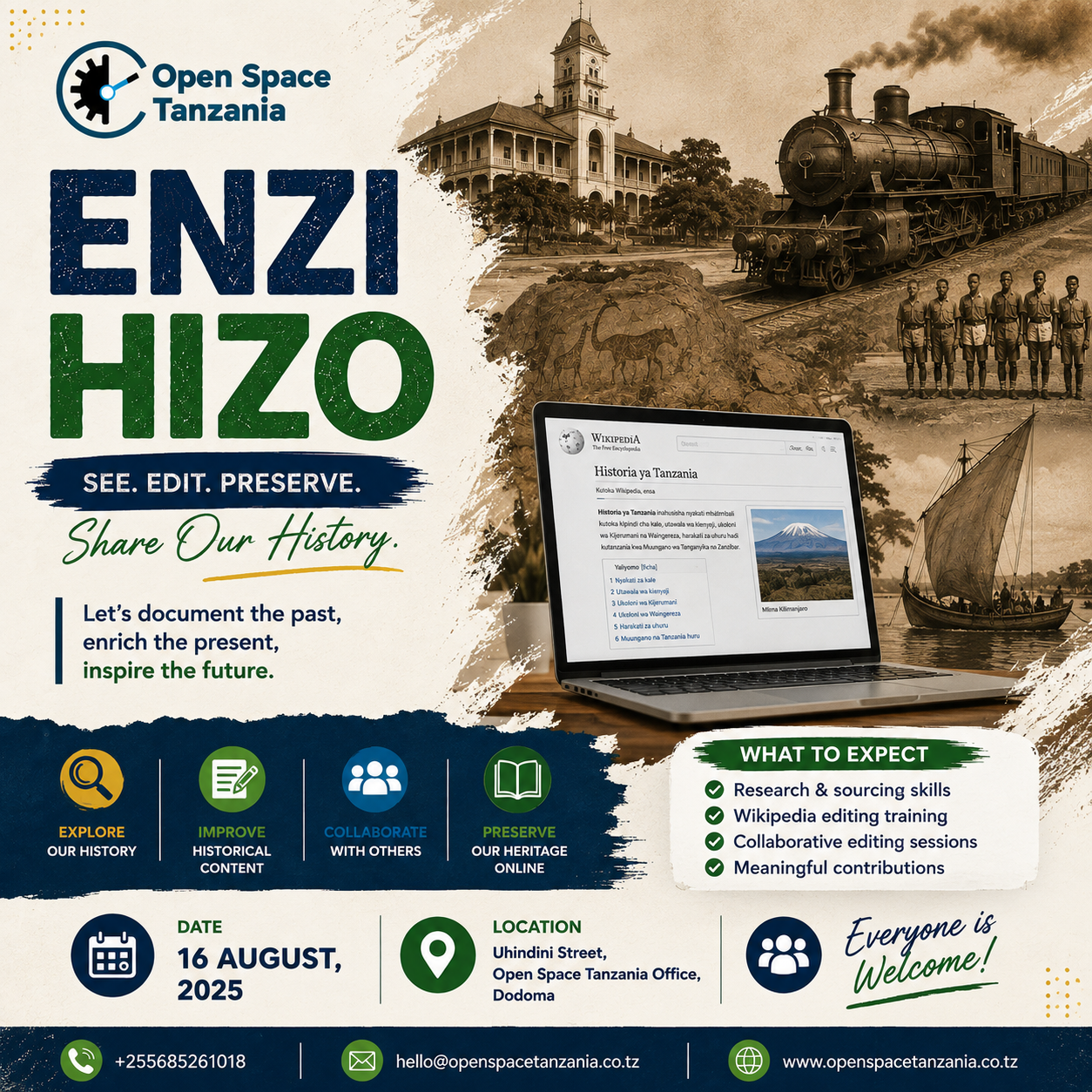
It was this challenge that inspired Enzi Hizo a community editing event organized by Open Space Tanzania under the Tanzania University Students Wikimedians (TUSW) 2025/2026 Project. Rather than treating history as something confined to museums or academic textbooks, the event invited university students to actively participate in documenting Tanzania’s past through Wikimedia projects, ensuring that historical knowledge becomes more accessible to readers everywhere.
Implemented on 16 August 2025, Enzi Hizo formed part of the project’s Reading Wikipedia in the Classroom (RWiC), Kiwix4Schools, and General Edit-a-thons programme. The activity provided participants with an opportunity to strengthen their research and editing skills while improving historical content using reliable sources and Wikimedia’s editorial standards. Project implementation included logistical support such as venue hire, internet connectivity, participant transportation, catering, and information technology equipment to facilitate collaborative learning.
More Than Looking Back
History often carries the perception of being static a collection of dates, names, and events that belong to another time. However, throughout Enzi Hizo, participants discovered that history is dynamic. Every newly published academic study, every digitized archive, and every documented historical site creates opportunities to improve public understanding.
Wikipedia reflects this reality. Articles evolve as new evidence becomes available, additional sources are published, and contributors work together to improve existing content. This perspective changed how many participants approached historical documentation. Instead of asking, “What happened?”, discussions increasingly focused on “How do we verify what happened?” and “Which sources best represent the historical record?”
That distinction became one of the defining characteristics of the event.
Building Knowledge Through Evidence
Unlike everyday conversations about history, contributing to Wikimedia requires every statement to be supported by reliable sources. This principle formed the foundation of the event. Participants explored how historians construct narratives using evidence rather than opinion. Books, peer-reviewed journals, government publications, academic research, and other credible references became the primary tools for improving articles.
As editing sessions progressed, participants quickly realized that writing for Wikipedia is fundamentally different from writing essays or expressing personal opinions.
Every contribution required careful consideration:
- Is this information supported by a reliable source?
- Does the source accurately represent the subject?
- Is the wording neutral?
- Can another editor verify the information independently?
These questions became part of the editing process itself, encouraging participants to think critically about both the information they encountered and the way it was presented.
Small Discoveries, Bigger Conversations
One of the most interesting aspects of Enzi Hizo was how seemingly small edits often led to broader conversations. While reviewing historical articles, participants identified missing references, outdated information, incomplete biographies, and opportunities to expand articles that had received little attention over the years.
These discoveries sparked discussions extending beyond technical editing.
Participants reflected on why certain historical figures receive greater visibility than others, why some regions are better documented than others, and how digital platforms can contribute to preserving diverse historical perspectives without compromising neutrality.
Such conversations highlighted an important aspect of Wikimedia’s collaborative model: improving knowledge is not only about adding information but also about identifying gaps that deserve further research.
When Local Knowledge Meets Global Platforms
One of the strengths of Wikimedia lies in its ability to connect local knowledge with a global audience. Throughout Enzi Hizo, participants naturally gravitated toward historical subjects connected to their own communities. Familiar places, regional histories, educational institutions, and notable personalities became common starting points for article improvement.
This was not simply because these topics were easier to understand.
Rather, contributors often felt a sense of responsibility to ensure that knowledge from their own communities was represented accurately and supported by credible evidence. From a Monitoring, Evaluation and Learning perspective, this observation reinforced an important pattern seen throughout the TUSW project: people are often most motivated to contribute when they recognize the value of sharing knowledge that reflects their own lived experiences.
Rather than reducing objectivity, this local familiarity frequently encouraged participants to invest more time in locating reliable references and ensuring that their contributions met Wikimedia’s quality standards.
Learning Beyond Editing
Although the event centered on Wikimedia editing, the learning extended far beyond technical skills. Participants strengthened their ability to evaluate information critically, distinguish between reliable and unreliable sources, organize evidence, and collaborate effectively with others.
Several participants commented that they had previously used Wikipedia without fully understanding the extensive review, discussion, and referencing processes behind many articles. By becoming contributors themselves, they gained a greater appreciation for the collaborative effort involved in maintaining one of the world’s largest open knowledge platforms. This change in perspective represents an important outcome that cannot easily be measured through article statistics alone.
Measuring Success Differently
Monitoring and evaluation often rely on quantitative indicators such as the number of participants trained, articles created, references added, or edits completed. These indicators remain valuable because they help demonstrate the scale of project implementation.
However, Enzi Hizo also highlighted the importance of qualitative change.
Success was equally reflected in participants who became more confident asking critical questions about information, contributors who learned how to evaluate historical sources more carefully, and volunteers who began supporting one another throughout the editing process. These less visible outcomes contribute significantly to building resilient Wikimedia communities capable of producing high-quality knowledge over time.
Lessons That Continued Throughout the Project
Every event implemented under the TUSW Project contributed to the design of subsequent activities, and Enzi Hizo was no exception. Several lessons emerged that influenced later thematic edit-a-thons and documentation initiatives.
First, participants responded positively to events built around a clearly defined theme. Focusing on history provided a common purpose that encouraged deeper discussion and stronger collaboration. Second, preparing reference materials before editing sessions significantly improved participant productivity. When reliable sources were readily available, contributors spent less time searching for information and more time improving articles.
Third, mentorship remained essential. Even participants with growing editing experience continued to benefit from guidance regarding sourcing, formatting, and Wikipedia’s editorial policies. These observations informed later activities focused on environmental documentation, governance, tourism, cultural heritage, and other thematic areas implemented throughout the project.
Challenges That Strengthened Future Planning
Like every learning activity, Enzi Hizo also presented challenges that generated valuable insights. Historical information is not always readily available in digital formats. Some topics required consulting printed books, institutional publications, or multiple sources before contributors felt confident making edits.
Participants also encountered situations where different sources presented historical events from slightly different perspectives.
These moments became practical learning opportunities for discussing Wikipedia’s Neutral Point of View policy and the importance of accurately reflecting what reliable sources state rather than selecting a preferred interpretation. These experiences strengthened participants’ understanding that responsible knowledge production requires patience, evidence, and careful editorial judgment.
Looking Forward
Preserving history is an ongoing process rather than a completed task.
As additional historical research becomes available and more archives are digitized, opportunities continue to emerge for improving Wikimedia’s coverage of Tanzania’s past. Open Space Tanzania views initiatives such as Enzi Hizo as part of a broader effort to strengthen digital knowledge ecosystems by equipping young people with the skills required to document information responsibly while contributing to publicly accessible knowledge.
By encouraging students to engage critically with historical sources, collaborate with peers, and contribute through open platforms, the project supports not only Wikimedia communities but also broader goals relating to digital literacy, research skills, and civic participation.
Final Reflection
History belongs to everyone, but preserving it increasingly depends on those willing to document it responsibly. Enzi Hizo demonstrated that university students can play an important role in ensuring that Tanzania’s historical narratives are better represented within global knowledge platforms. Through research, collaboration, and careful adherence to Wikimedia’s principles of neutrality and verifiability, participants contributed to a growing body of freely accessible knowledge while strengthening skills that extend well beyond the editing interface.
Perhaps the most enduring outcome of the event was not a single article or edit, but a shift in perspective. Participants left with a deeper understanding that history is not only something to study it is also something to preserve, improve, and share responsibly so that future generations can access knowledge that is accurate, balanced, and reflective of the communities from which it comes.