
There is a common saying that when a language disappears, a unique way of understanding the world disappears with it. Languages carry stories, traditions, histories, and ways of thinking that cannot easily be translated into another culture. In today’s increasingly digital world, however, preserving a language is no longer limited to books, classrooms, or oral traditions. It also means ensuring that knowledge exists where millions of people now search for information online every day.
For Tanzania, this presents both an opportunity and a responsibility.
Swahili is one of Africa’s most widely spoken languages and serves as an important medium for education, governance, commerce, and cultural identity. Yet despite its importance, much of Tanzania’s knowledge remains underrepresented on freely accessible digital platforms. Many local histories, biographies, cultural practices, geographical locations, and educational resources either receive limited coverage or remain entirely absent from the world’s largest collaborative knowledge platforms.
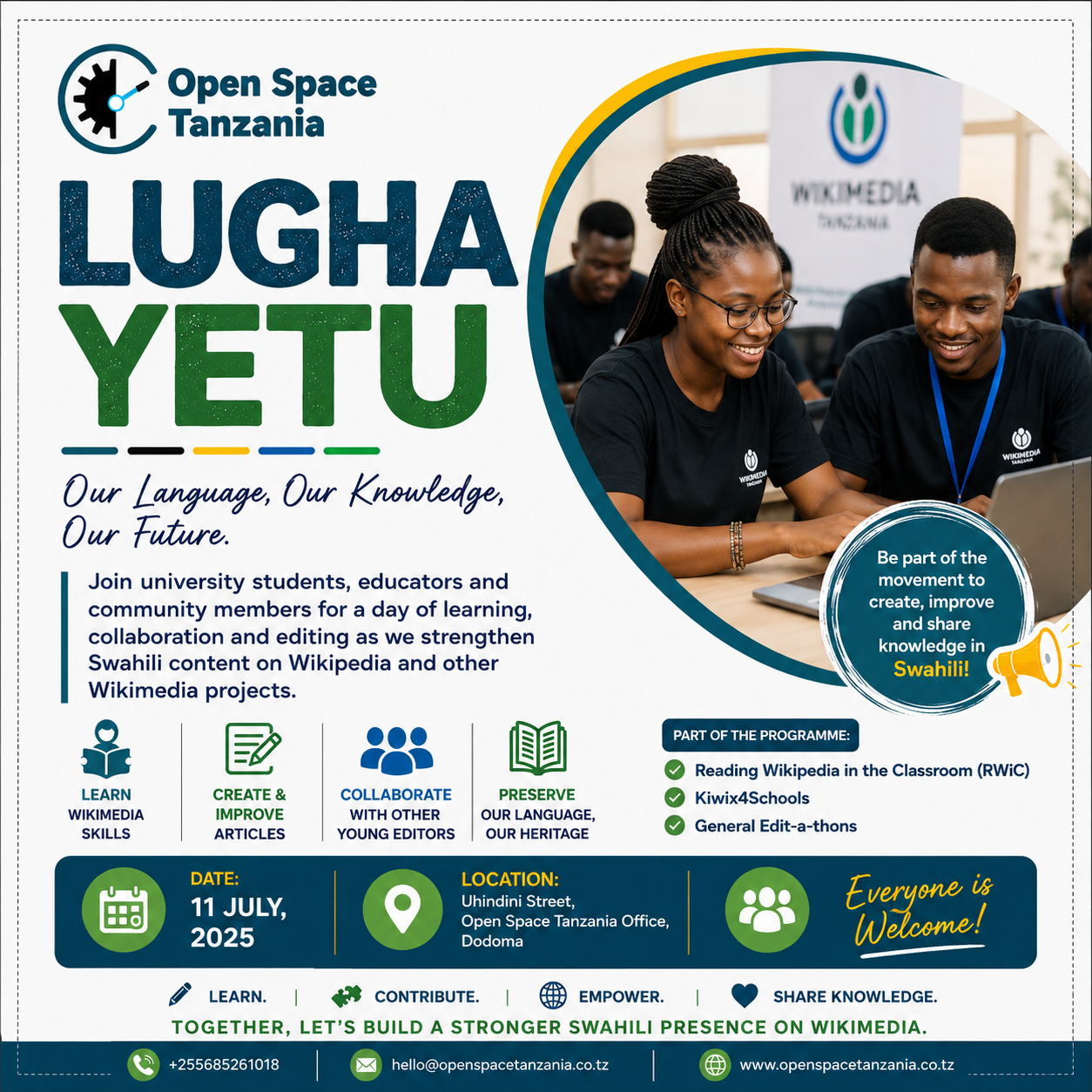
Recognizing this gap, Open Space Tanzania, through the Tanzania University Students Wikimedians (TUSW) 2025/2026 Project, launched Lugha Yetu (“Our Language”)an event that sought to introduce university students to Wikimedia while encouraging them to become active contributors to the preservation and sharing of knowledge in Swahili.
Held on 11 July 2025, the event formed part of the broader Reading Wikipedia in the Classroom (RWiC), Kiwix4Schools, and General Edit-a-thons programme. Participants came together not simply to learn how Wikipedia works, but to explore how they could help make knowledge about Tanzania more visible, accessible, and reliable. The activity was supported through investments in venue rental, internet connectivity, transportation, event materials, and information technology equipment that enabled practical participation.
Beginning with a Simple Question
Every Wikimedia editor starts with the same realization: the encyclopedia that millions of people read every day is written by ordinary people.
For many participants attending Lugha Yetu, this realization changed the way they viewed Wikipedia. Most had used it for years as readers. Few had imagined that they could also become contributors.
The event was intentionally designed around this transition from reader to contributor.
Instead of beginning with technical instructions alone, facilitators introduced participants to the philosophy of the Wikimedia movement: knowledge grows through collaboration, transparency, and the collective efforts of volunteers who are committed to sharing reliable information with the world.
This broader understanding helped participants appreciate that editing Wikipedia is not simply about changing words on a webpage. It is about contributing responsibly to a shared public resource.
Learning Through Participation
Once participants understood the principles behind Wikimedia, the focus shifted to practice.
Working in small groups, participants created user accounts, explored existing articles, learned how references support credibility, and gradually began making their first edits. Experienced Wikimedia volunteers provided guidance throughout the process, helping participants navigate technical challenges while encouraging collaboration and discussion.
The atmosphere in the room evolved noticeably as the day progressed.
Initial uncertainty gradually gave way to curiosity. Questions that first focused on “How do I edit?” soon became conversations about “What knowledge from my community should be documented?” and “How can we improve articles that people read every day?”
This shift represented one of the most significant outcomes of the event.
Participants were no longer simply learning software; they were beginning to see themselves as contributors to a much larger knowledge ecosystem.
Why Swahili Matters
Choosing Swahili as the central focus of the event was intentional.
As one of Africa’s most influential languages, Swahili connects millions of people across East and Central Africa. Yet language alone does not guarantee representation. Knowledge must also be documented, referenced, maintained, and continuously improved.
When participants contributed articles in Swahili or expanded topics relating to Tanzania, they were doing more than increasing the number of available articles. They were helping ensure that local experiences, histories, and perspectives become part of the global digital knowledge landscape.
Many participants naturally gravitated toward subjects connected to their own communities. Local history, education, cultural traditions, and notable places became common themes during editing sessions.
From a Monitoring, Evaluation and Learning perspective, this observation was particularly encouraging. Contributors often demonstrate stronger motivation when working on topics they know personally, suggesting that local relevance is an important driver of long-term community participation.
Looking Beyond the Number of Articles
Projects that support Wikimedia activities are often measured through quantitative indicators; articles created, references added, images uploaded, or editors trained.
While these metrics remain important, they tell only part of the story.
Lugha Yetu demonstrated that the early stages of community building are equally about confidence, curiosity, and collaboration.
Several participants arrived believing that Wikipedia was a finished product maintained by experts somewhere else. By the end of the event, many understood that Wikipedia is continuously improved by volunteers working together across the world, and that they themselves could become part of that process.
That change in perspective may not immediately appear in a dashboard, but it represents one of the foundations upon which sustainable Wikimedia communities are built.
Learning That Extended Beyond the Event
Every community activity provides an opportunity not only for participants to learn but also for organizations to improve how they work.
For Open Space Tanzania, Lugha Yetu became an important learning experience.
Facilitators observed that participants gained confidence much faster when practical exercises were introduced early in the programme rather than after lengthy presentations. Working in smaller groups also encouraged questions that participants might have hesitated to ask in larger sessions.
The event further highlighted the value of peer mentorship. Experienced editors not only solved technical problems but also helped newcomers understand Wikimedia’s culture of collaboration, respectful discussion, and evidence-based editing.
These observations influenced the design of later project activities, where greater emphasis was placed on practical learning, continuous mentorship, and collaborative editing.
Challenges That Became Learning Opportunities
No community activity is without challenges.
Participants joined the event with different levels of digital literacy and varying familiarity with online collaborative tools. Some adapted quickly, while others required additional support during account creation, editing, and citation.
Reliable internet connectivity also affected the pace of practical sessions, reminding organizers that successful digital learning depends on both human and technical resources.
Rather than viewing these issues as setbacks, the project team documented them as opportunities for improvement. Subsequent activities incorporated longer practical sessions, increased facilitator support, and stronger follow-up mechanisms for new contributors.
This iterative approach reflects one of the central principles of Monitoring, Evaluation and Learning: each activity should strengthen the next.
A Foundation for the Year Ahead
Although Lugha Yetu was one of the first activities implemented under the TUSW 2025/2026 Project, its influence extended well beyond a single day.
Many of the facilitation approaches, mentorship practices, and community engagement strategies refined during Lugha Yetu were later applied across subsequent initiatives, including Enzi Hizo, COP in Wiki, Women in Wiki, JoT in Wiki, and several other thematic campaigns implemented throughout the year.
In this way, the event became more than an introduction to Wikimedia. It served as the project’s first learning milestone a point at which both participants and organizers began understanding what would be required to build a resilient, collaborative Wikimedia community within Tanzanian universities.
Looking Forward
The journey toward strengthening Swahili knowledge online cannot be completed through a single event. It requires continued collaboration among students, educators, institutions, and volunteers who recognise the value of preserving local knowledge within global digital spaces.
Lugha Yetu demonstrated that when young people are provided with practical skills, supportive mentorship, and opportunities to document the knowledge they already possess, they are willing to contribute meaningfully to the world’s shared knowledge resources.
For Open Space Tanzania, this remains one of the most important lessons from the event: sustainable Wikimedia communities are built not only by teaching people how to edit, but by helping them understand why their knowledge matters.
As the TUSW community continues to grow, the conversations that began during Lugha Yetu continue to shape a broader movement, one in which university students are not simply consumers of information but active stewards of Tanzania’s digital knowledge for future generations.